
WHAT KIND OF BRANDING IS RIGHT FOR BOUTIQUE LAW FIRMS?
A focused expert branding strategy is well-suited for specialized boutique law firms. It combines professional expertise with the needs of select client groups and a distinct brand identity.
Five key elements are crucial: a clear positioning, well-defined target audiences, verifiable evidence of expertise, a distinctive brand image, and targeted communication.
The goal is not to appeal to as many people as possible, but rather to be perceived by the right people as the right law firm.
In this context, “boutique” is not a matter of the firm’s size. What matters is specialization in selected areas of law, industries, or complex advisory situations. Even multiple areas of law can result in a clear profile if they follow a common professional focus.

Law Firm Positioning: Specialization Is Just the Beginning
"We specialize in business law."
That’s a statement of fact. But it’s not yet a compelling positioning statement.
It doesn’t answer which clients the firm targets, nor does it explain what challenges its specific expertise addresses.
A strong law firm positioning therefore answers four questions: What do we stand for? Who do we want to reach? What problems do clients need us to solve? And how do we differentiate ourselves from other law firms?
For boutique law firms, there are three strategic approaches:
Specialization by practice area: The firm focuses on a clearly defined practice area, such as white-collar crime, antitrust law, or intellectual property.
Specialization by industry: The firm positions itself as an advisory partner for a specific industry, such as real estate, healthcare, or technology-oriented companies.
Specialization by client situation: The focus is on specific advisory situations such as shareholder disputes, business succession, or employment law issues involving executives.
Combining these approaches can be particularly effective.
For example, a general “corporate law firm” becomes a firm that focuses on shareholder disputes and succession planning in owner-managed companies.
A law firm should be able to do more than what it describes in the first sentence. What matters is which area of expertise should stick in the reader’s mind.

Five Building Blocks of a Successful Branding Strategy
1. Understanding Target Audiences
Not every client seeks legal assistance in the same way.
An international general counsel has different expectations than an entrepreneur facing a personal crisis. That’s why target audiences must be defined beyond industry and company size.
What questions are on potential clients’ minds? What influences their decision? And what evidence of expertise do they expect?
Answering these questions lays the foundation for relevant law firm communication.
2. Analyze the Competition and Sharpen Your Profile
Many law firms use the same terms in their messaging: competent, experienced, personal.
That may be true, but it does little to set a law firm apart.
A competitive analysis reveals which positions are already occupied and where differentiation is possible. This leads to a strategic firm positioning that combines professional strengths, target audiences, and the firm’s own advisory approach.
After all, relevance doesn’t arise in a vacuum.
3. Develop a Distinctive Brand Identity
Brand identity stems from this positioning: How does the law firm communicate? What messages take center stage? What image should it convey?
This includes a clear linguistic tone, concise core messages, and a corporate design that visually conveys the firm’s character.
The logo, colors, typography, and visual language form a cohesive system. Not every law firm needs dark blue, classic columns, or the usual legal imagery.
What matters most is that the design and content align credibly.
Learn more: Law Firm Branding & Corporate Design.

4. Showcase Your Expertise
A specialization gains credibility when it is communicated in a clear and understandable way.
This includes informative attorney profiles, relevant professional publications, specific areas of practice, and, where appropriate, relevant case examples.
The law firm’s website plays a central role in this. It must not only look professional but also structure information in an understandable way and guide potential clients to make contact.
Good law firm web design therefore combines brand identity, user navigation, and professional content.
5. Build Visibility Strategically
Not every boutique law firm needs every marketing channel.
For specialized commercial law firms, for example, professional publications, LinkedIn, personal networks, and a search engine-optimized website can be particularly effective.
It’s important that all efforts support the same positioning.
Clearly structured, professionally relevant content is also a key foundation for visibility on Google, Bing, and AI systems like Microsoft Copilot.
Firms that answer specific questions and present their expertise in a clear and understandable way create better conditions for being found through relevant search queries and considered as a source of information.
Read more: SEO for Law Firms.

Case Study: Branding for BRUNS legal
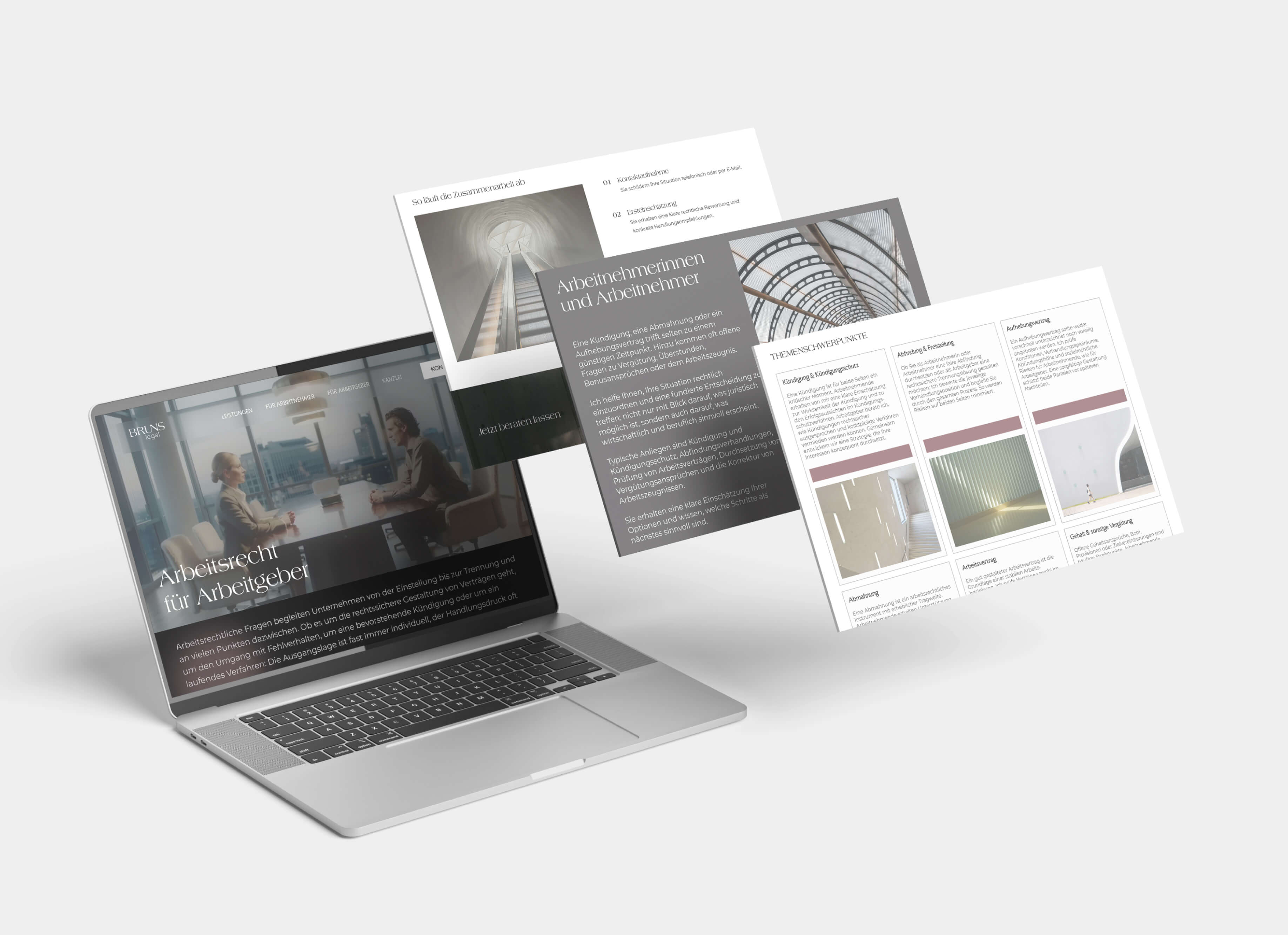
Our project for BRUNS legal, a specialized employment law firm in Munich, demonstrates how a clear positioning can be translated into a distinct brand identity.
The starting point was the firm’s founder’s approach to advising clients: clear assessments, transparent communication, and a precise handling of her clients’ concerns.
Based on this, vierzehn02 developed a corporate design that deliberately avoids classic law firm clichés. A subdued color palette of gray and off-white, distinctive typography, and a unique visual language convey the firm’s ethos.
The website also follows this concept. It is structured around specific consulting scenarios and guides visitors in a structured way to the relevant information.
This example illustrates how professional focus, brand identity, and digital user guidance work together.
It is not the design that defines the firm’s character. The character defines the design.
Conclusion: The strongest position is rarely the broadest.
Boutique law firms may not be the right fit for everyone.
Firms that consistently align their specialization with the needs of a clearly defined target audience lay the foundation for a strong expert brand.
A good branding strategy captures this positioning—in language, design, and all communication.
Not louder than the others—but clearer.

STILL IN THE RACE?

We’ll figure out if we’re a good fit during our conversation. vierzehn02 develops corporate websites—from positioning and concept development to UX/UI design and technical implementation.
And yes: We ask quite a few questions at the beginning.

